Sourdough Starter for Beginners: It's All About Hydration
What a bread starter actually is, why it's worth keeping (and why you might not need one), and how to use it for poolish, a sourdough loaf and pizza. Spoiler: the number that matters is water.
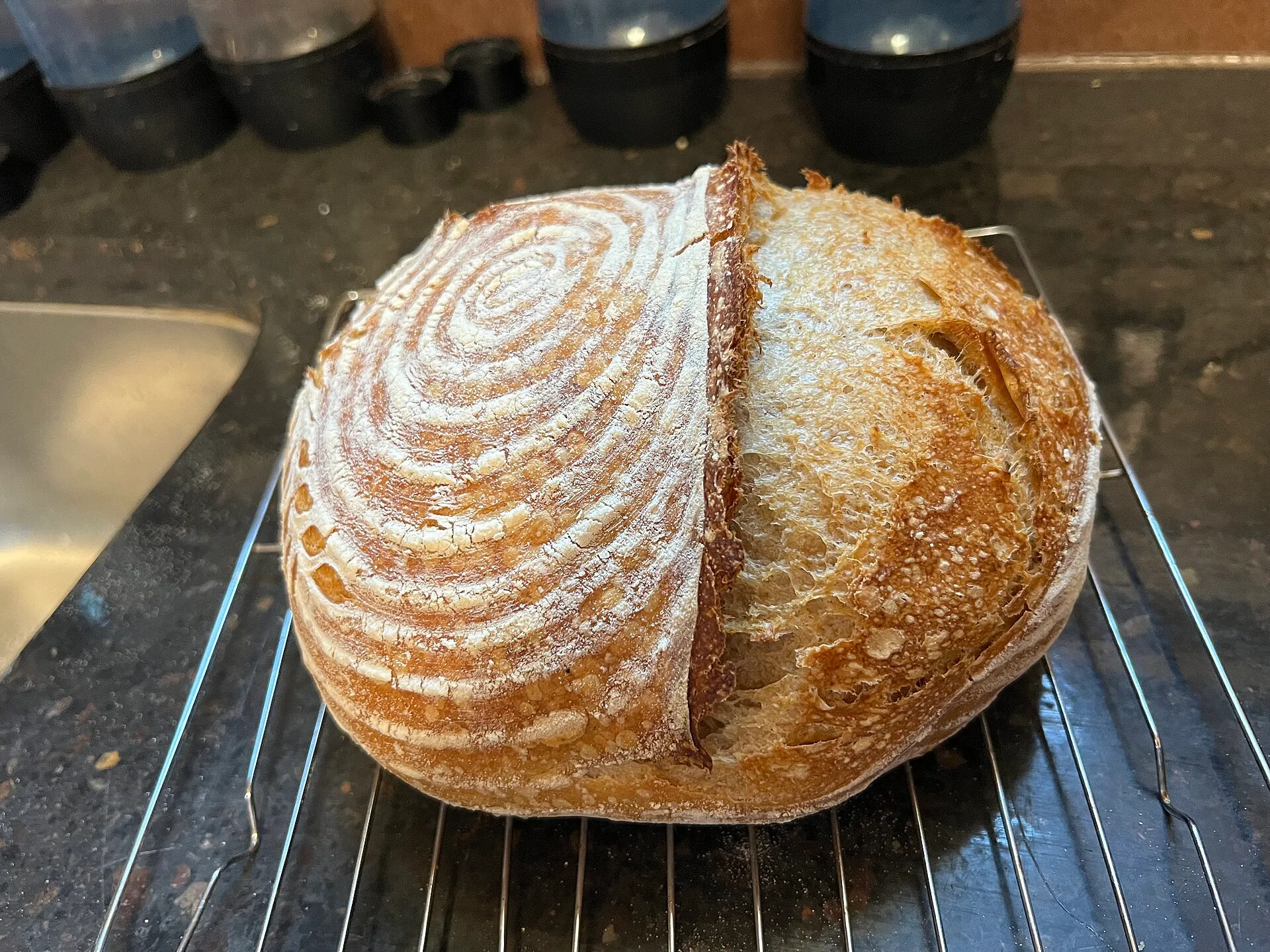
Around 2020 everybody had a jar. It sat on the counter, it had a name, and its owner talked about it the way people talk about a difficult cat. Then most of those jars quietly died in the back of a fridge, and their owners went back to buying bread.
Fair enough. A starter is not magic and it is not mandatory. But it is one of the strangest and most satisfying things you can keep in a kitchen, and once you understand the single idea behind it, poolish, sourdough and pizza stop being three separate religions and turn into one recipe with different amounts of water.
That idea is hydration. We’ll get there.
And yes, the jar in the corner of this site that rises towards Friday finally gets its explanation.
What a starter actually is
A sourdough starter is flour and water that has been left alone long enough to get colonised. That’s it. No packet, no secret ingredient, no grandmother required.
Flour is not sterile. It carries wild yeasts and bacteria from the field, the mill and your hands. Mix it with water, keep it warm, feed it fresh flour every day, and the microbes that like this environment win while the rest die off. After a week or two you have a stable little ecosystem living in a jar.
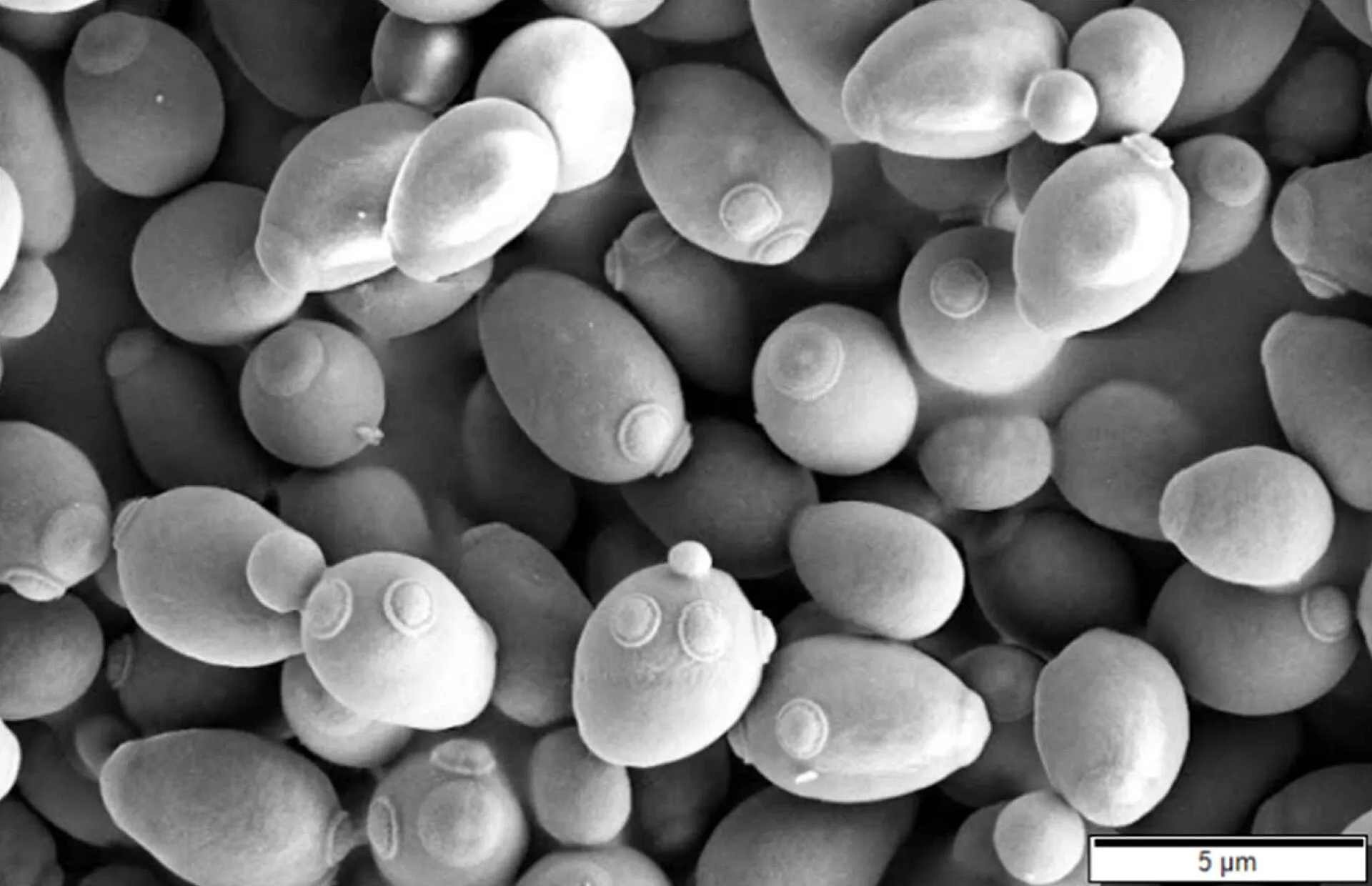
That ecosystem has two kinds of tenants:
- Wild yeasts eat sugars from the flour and burp out carbon dioxide and alcohol. The CO₂ is what lifts your bread.
- Lactic acid bacteria (LAB) eat the same sugars and produce lactic and acetic acid. That’s the sour in sourdough. In a healthy starter they outnumber the yeasts roughly a hundred to one.
The acid is also why the whole thing works. It makes the jar hostile to mould and most of the nasty stuff, so the yeast and the bacteria get the place to themselves. It’s a zoo where the residents built their own fence.
The thing you buy in a packet is a single carefully bred strain of baker’s yeast, Saccharomyces cerevisiae, selected to be fast and predictable. A starter is a whole team. Slower, moodier, and with much more opinion about flavour.
Why it’s interesting
Because people have been doing this for a ridiculously long time.
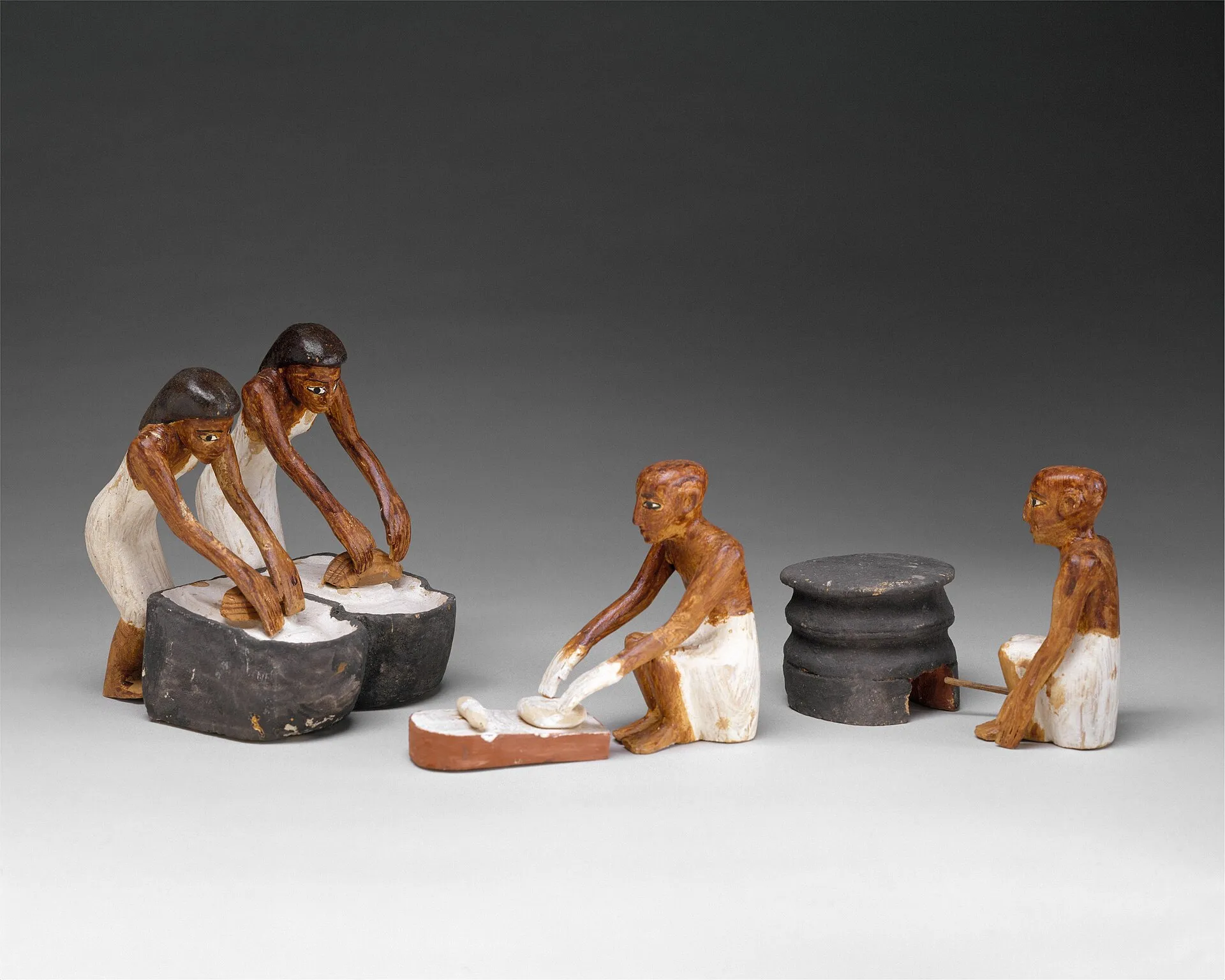
These little guys are from the tomb of Meketre, an Egyptian official, roughly four thousand years ago. They are grinding grain and working dough for the afterlife. Nobody in that room had a packet of instant yeast. For most of human history, leavened bread rose on a saved, fed, sour culture or on yeasty foam skimmed off brewing beer (note the brewery in Meketre’s model). Commercial baker’s yeast only turned up in the 19th century.
So when you feed a jar of flour paste you are, in a small and slightly silly way, running the same process as most bakers who ever lived.
The practical reasons are good too:
- Flavour. The bacteria make acids and aromatic compounds that baker’s yeast alone doesn’t. Tangy, nutty, a little like yogurt or apple, depending on how you keep it.
- Keeping quality. Acidic bread goes stale and mouldy slower. A sourdough loaf is still good on day three when the supermarket one is a weapon.
- It’s free and it replicates. You’ll never run out of yeast again. You’ll also have more of it than you know what to do with. That’s a feature, mostly.
- It’s alive, and you learn to read it. That sounds like a fridge-magnet slogan, but it’s the real reason people keep starters. You start noticing temperature, smell, timing. You become a better baker even when you’re using a packet.
Why you might not need one
Here’s the part that sourdough Instagram leaves out.
Most of the flavour in good bread comes from time, not from wild microbes. A long, cool fermentation lets enzymes break starch into sugars and lets the yeast produce aromatic by-products. You get most of that with commercial yeast if you use very little of it and wait. A poolish with a pinch of instant yeast, left overnight, makes bread that will embarrass most bakeries.
So skip the starter if:
- you bake once a month or less. A starter wants feeding at least weekly, and you’ll end up with a jar of guilt;
- you want predictable timing. A starter rises faster on a hot day and sulks on a cold one;
- you don’t actually like sour bread. Yes, you can keep it mild, but it takes effort;
- you are doing it for health. Sourdough has a lower glycaemic response and better mineral availability than fast yeast bread, but it is not gluten-free and not safe for people with coeliac disease. Anybody who tells you otherwise is selling a course.
If none of these apply, or if you’re simply curious, make one. It costs a few hundred grams of flour and two weeks of attention.
It’s all about hydration
Bakers measure everything against flour. Flour is always 100%, and everything else is a percentage of it. This is called baker’s percentage, and the most important number in it is:
hydration = water ÷ flour × 100500 g of flour and 350 g of water is 70% hydration. That’s the whole formula.
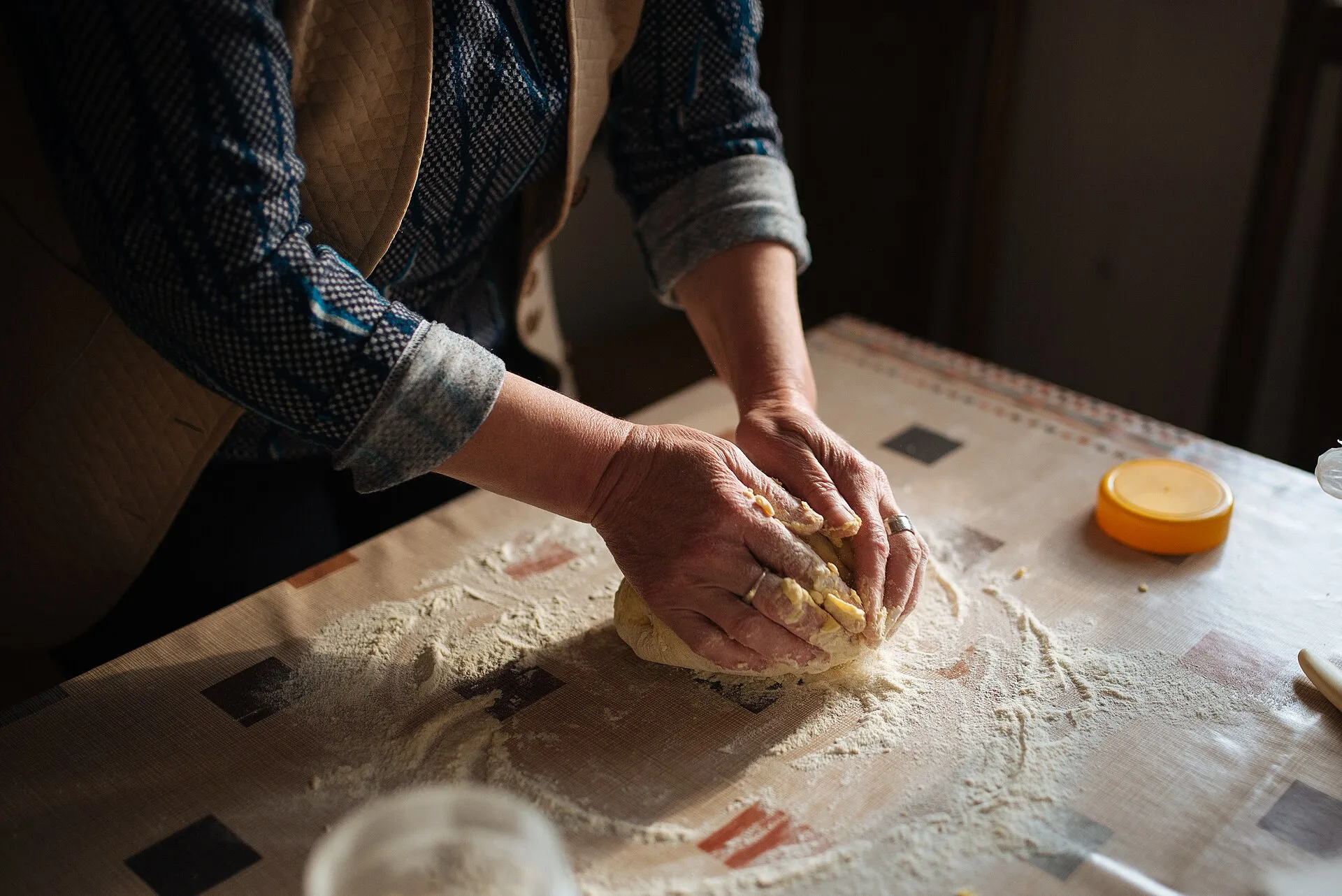
Hydration decides what kind of bread you make far more than any other single choice. Roughly, with ordinary bread flour:
| Dough | Hydration | What it feels like |
|---|---|---|
| Bagels | 55–58% | Stiff, like play-dough. Your wrists will complain. |
| Neapolitan pizza | 58–65% | Soft and smooth, barely tacky |
| Sandwich loaf | 60–68% | Easy, friendly, the dough from cookbooks |
| Home-oven pizza | 65–70% | Sticky but manageable |
| Country sourdough | 70–80% | Wobbly, sticky, needs folding instead of kneading |
| Ciabatta, focaccia | 75–90% | Batter with ambition |
More water means a more open crumb, bigger holes, thinner crispier crust, and a dough that’s harder to handle. Less water means tighter crumb, chewier bite, easier shaping.
Two catches:
- Flour changes the feel. Whole wheat and rye drink much more water than white flour. 70% with whole wheat feels like 62% with white. The number is a ratio, not a promise about texture.
- Your starter is part of the dough. This is the one beginners miss. A starter at 100% hydration is half flour and half water. Add 100 g of it to a recipe and you just added 50 g of flour and 50 g of water. Count them, or your 70% dough will quietly become 73% and you’ll wonder why it’s a puddle.
The water hiding in your starter
Hidden water: 70% just became 72.7%.
Your starter has a hydration too
And this is where it all clicks. A starter is a preferment: a portion of the dough fermented ahead of time. Bakers have names for preferments, and the names are mostly about hydration:
| Preferment | Hydration | Leavened with |
|---|---|---|
| Poolish | ~100% | A pinch of commercial yeast |
| Liquid starter (levain) | ~100% | Wild yeast + bacteria |
| Biga | ~45–60% | A pinch of commercial yeast |
| Stiff starter (lievito madre) | ~50–60% | Wild yeast + bacteria |
See the pattern? A liquid starter is a poolish with a wild culture instead of a packet. A stiff starter is a biga with a wild culture. Two dials: how much water, and who’s doing the eating.
The hydration of your starter changes its behaviour as well. A liquid starter ferments faster and tastes milder and more yogurty. A stiff one is slower, more forgiving if you’re late to feed it, and leans towards a sharper, vinegary tang. Neither is better. Most beginners should start with 100%, because equal weights are easy to remember at seven in the morning.
Making a starter
You need a jar, a kitchen scale, flour and water. Whole wheat or rye flour for the first days helps a lot, because it carries more microbes and more food than white flour. If your tap water tastes like a swimming pool, use filtered.
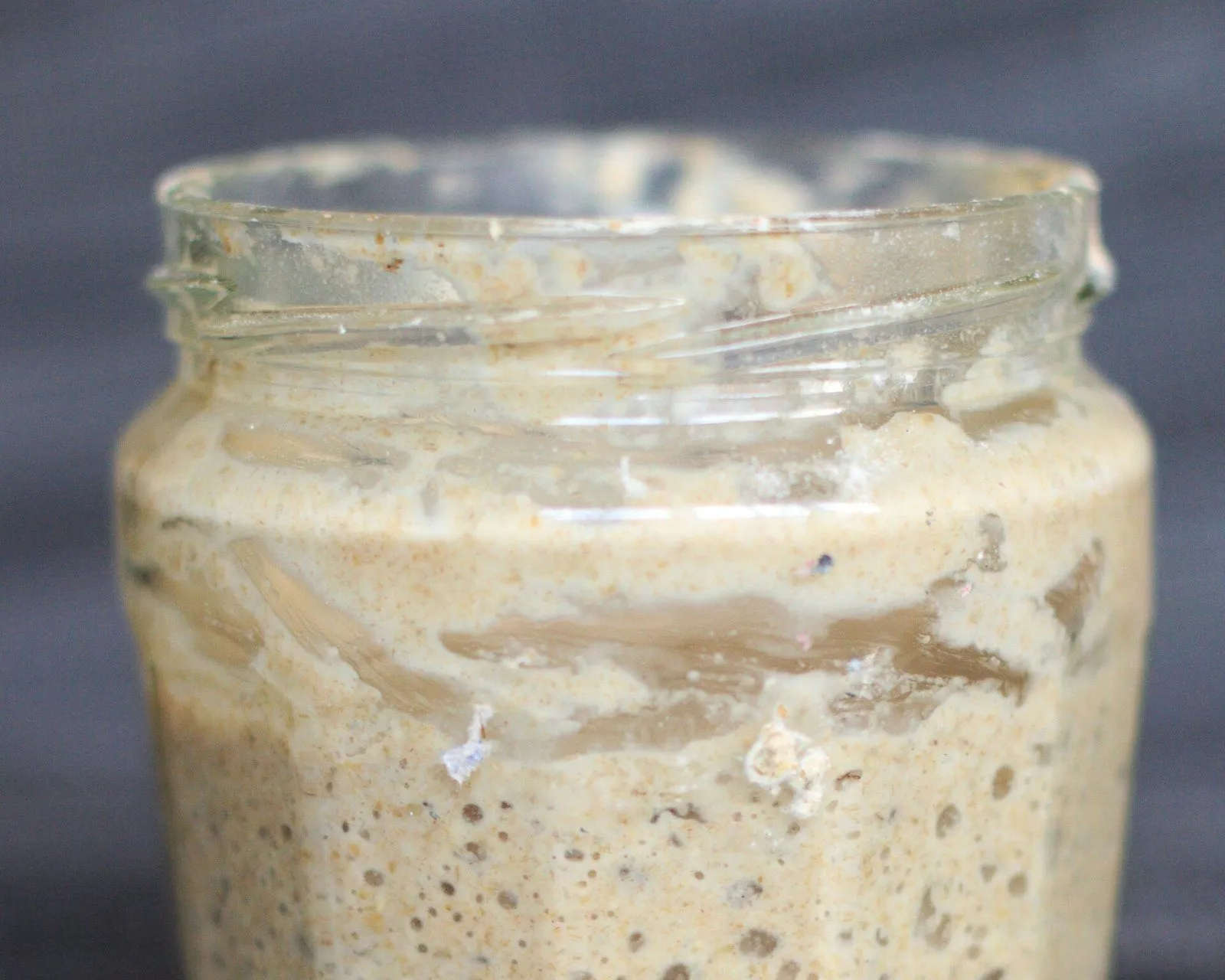
- Day 1. Mix 50 g whole wheat or rye flour with 50 g lukewarm water. Cover loosely and leave it somewhere around 24–26 °C.
- Day 2. Maybe bubbles, maybe nothing. Discard all but 50 g, add 50 g flour and 50 g water, stir.
- Days 3–4. It might rise dramatically and smell weird, then go completely dead. Don’t throw it out. The first burst is usually bacteria that can’t handle the rising acidity. They die, things go quiet, and the real tenants move in.
- Days 5–14. Keep feeding the same way once a day, twice if it’s hot. You can switch to white flour or keep a mix.
The first two weeks
- early bacteria
- lactic acid bacteria
- yeast
Dead quiet. The acid got them. Don’t throw it out.
It’s ready when it reliably doubles within 4–8 hours after feeding, has a domed, bubbly top, and smells pleasantly sour and yeasty. Nail-polish smell means hungry. Cheese or vomit smell in the first week is normal; in week three it isn’t.
Mark the level with a rubber band after each feed. You’ll learn more from that band than from any guide, including this one.
Feeding and keeping it alive
Feeding is described as a ratio of starter : flour : water by weight.
- 1:1:1 (50 g starter, 50 g flour, 50 g water) peaks in about 4–6 hours at room temperature.
- 1:2:2 peaks in about 6–8 hours.
- 1:5:5 peaks in about 10–12 hours. Feed it before bed, bake in the morning.
Bigger ratio, slower peak, milder flavour. That’s your timer, and it’s the main way to make a starter fit your life instead of the other way round.
Feeding ratio race
Breakfast, and 1:5:5 is at its peak. Bake.
If you don’t bake daily, keep it in the fridge. Feed it, let it get going for an hour or two, then put it away. Feed once a week. Before baking, take it out and give it one or two feeds at room temperature to wake it up.
Grey liquid on top is called hooch. It’s alcohol, and it means the starter is hungry. Pour it off for a milder starter or stir it back in for more tang, then feed. The only real reason to give up on a jar is fuzzy mould or pink or orange streaks. Then you bin it and start again; it’s flour and water, not a pet.
Okay, it’s a bit of a pet.
The discard, the bit you pour off before each feed, makes excellent pancakes and crackers. Keep a second jar in the fridge for it.
Using it
Everything below uses a ripe 100% starter, meaning fed and at or near its peak: domed, bubbly, roughly doubled. Using a starter that peaked hours ago is one of the most common reasons for flat bread.
Poolish
Strictly, a poolish uses commercial yeast. Use starter instead and bakers will call it a liquid levain. Your dough won’t care about the name, so here’s how to make one either way.
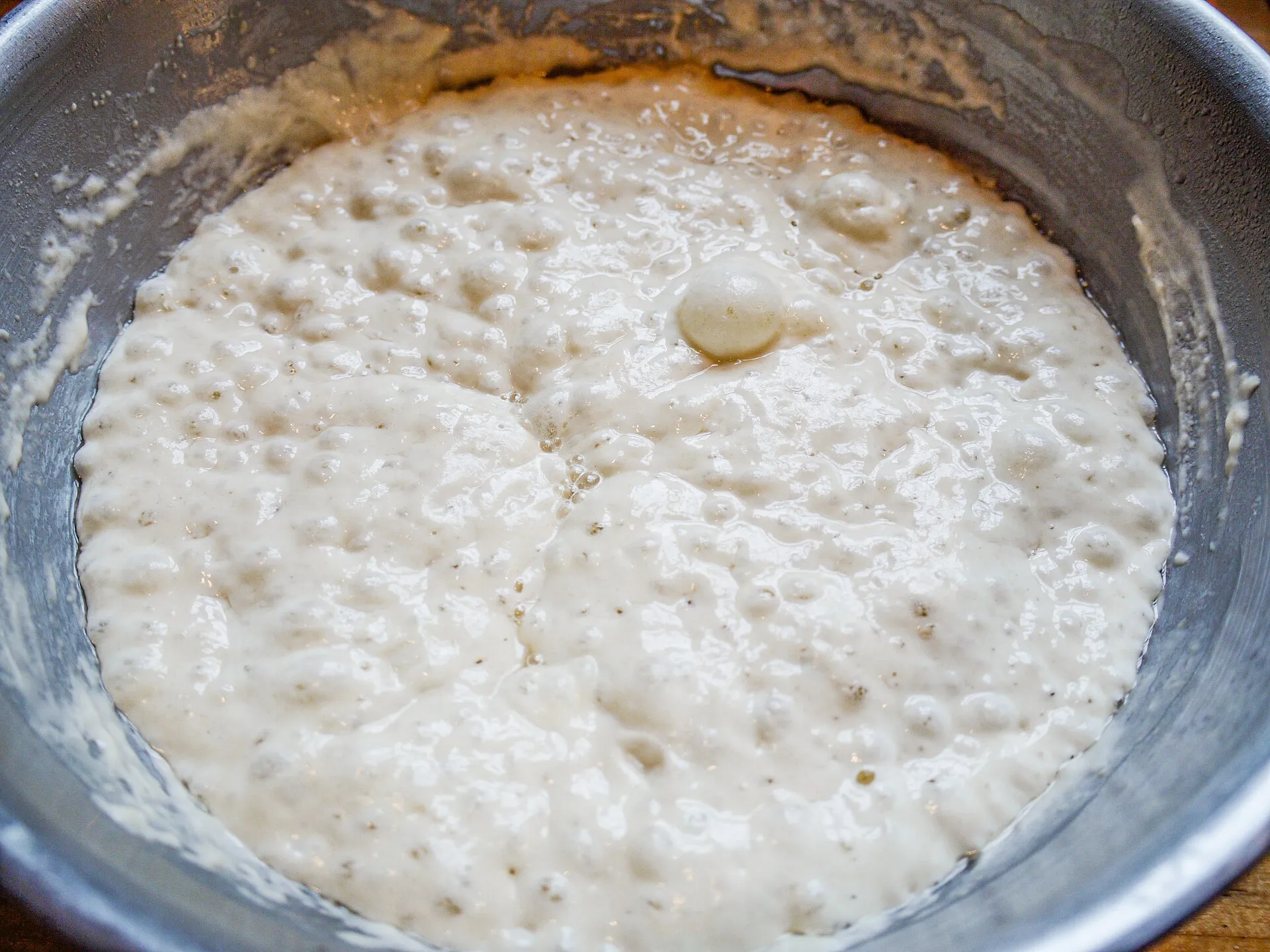
The preferment, the night before:
- 200 g flour
- 200 g water
- 20 g ripe starter, or a tiny pinch (0.2 g) of instant yeast
Stir, cover, leave at room temperature for 10–14 hours. It’s ready when it’s full of bubbles and the surface just starts to sag in the middle.
The dough, next morning:
- all of the poolish
- 300 g flour
- 150 g water
- 10 g salt
That comes to about 510 g flour and 360 g water, or ~70% hydration. Mix, fold every 30 minutes for two hours, then let it rise until it’s grown by half, shape and bake. This dough makes very good baguettes, focaccia, or a rustic loaf.
If you want the flavour of a sourdough poolish but less waiting, add 2 g of instant yeast to the final dough. That’s called a hybrid, and no, the sourdough police won’t come.
A sourdough loaf
One loaf, about 950 g of dough:
- 450 g bread flour
- 50 g whole wheat flour
- 350 g water
- 100 g ripe starter
- 10 g salt
Total flour is 550 g (including the 50 g hiding in the starter), total water is 400 g: ~73% hydration. Wet enough for an open crumb, dry enough to shape on your first try.
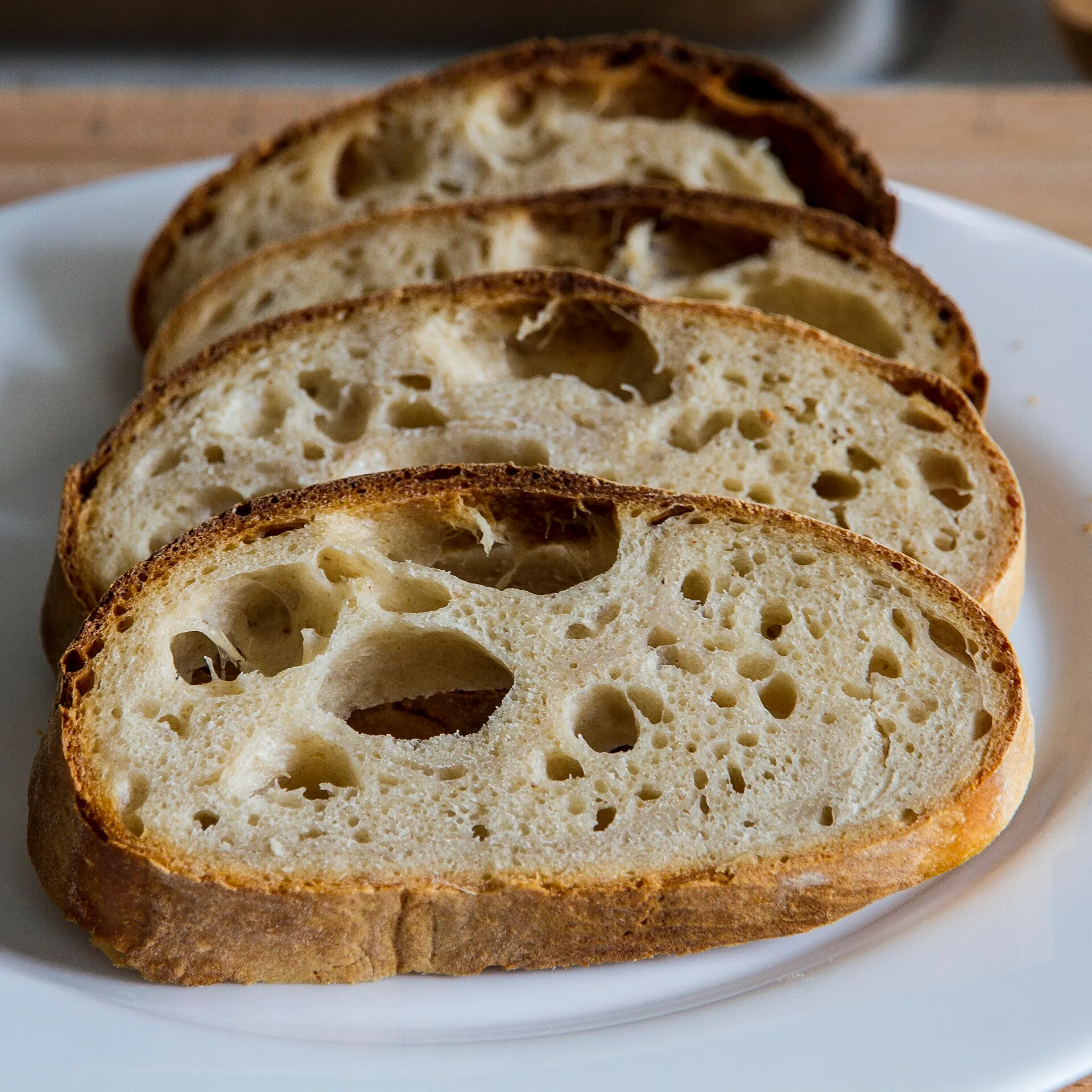
- Mix the flours and water, leave for 30–60 minutes. This rest is called autolyse; the flour hydrates and gluten starts forming on its own.
- Add the starter and salt, squeeze them in with wet hands until the dough comes together.
- Over the next two hours, do a set of stretch and folds every 30 minutes: grab one side, stretch it up, fold it over, turn the bowl, repeat four times.
- Let it rise until it has grown by about 50% and the top is domed with a few bubbles. Usually 4–6 hours at 24 °C. Watch the dough, not the clock.
- Shape into a tight ball, put it seam-up in a floured bowl or banneton, cover, and refrigerate overnight (8–16 hours).
- Bake straight from the fridge in a preheated Dutch oven: 250 °C with the lid on for 20 minutes, then 230 °C with the lid off for another 20–25, until it’s darker than you think is reasonable.
Let it cool for at least an hour. Cutting it hot is how you get a gummy crumb and a lesson.
Pizza
Four 250 g balls:
- 560 g flour (Italian 00 or bread flour)
- 340 g water
- 80 g ripe starter
- 16 g salt
Total flour 600 g, total water 380 g: ~63% hydration. That’s in Neapolitan territory, which suits a very hot oven. If you bake in a home oven that tops out around 250–280 °C, push the water up to 360–380 g (67–70%). A longer bake dries the dough more, so you start wetter.

- Mix everything except the salt, rest 20 minutes, add salt and knead or fold until smooth.
- Leave covered at room temperature for 3–4 hours, folding once or twice.
- Divide into four balls, put them in a lightly oiled container, and refrigerate for 24–72 hours. This is where the flavour comes from; this is not the step to skip.
- Take them out 2–3 hours before baking. Stretch by hand, never with a rolling pin, which flattens the air you spent three days collecting.
- Bake as hot as your oven goes, ideally on a preheated steel or stone.
Sourdough pizza has a slightly tangy, very crisp crust that commercial yeast doesn’t quite give you. It’s also the most forgiving of the three bakes, so if your first loaf is a frisbee, make pizza.
Swapping yeast for starter in any recipe
Got a favourite recipe that uses instant yeast? Here’s the rule of thumb:
- replace the yeast with ripe starter at about 20% of the flour weight;
- subtract half the starter’s weight from the flour and the other half from the water;
- expect the rise to take two to three times longer.
For a recipe with 500 g flour, 350 g water and 7 g yeast: use 100 g starter, 450 g flour, 300 g water. The hydration stays exactly where the recipe wanted it, which, as we’ve established, is the whole game.
Swap the yeast, keep the hydration
Half off the flour, half off the water. Still 70%.
When it goes wrong
Almost every beginner problem is one of these:
- The starter wasn’t ripe. Bake at or just before the peak, not hours after it collapsed.
- The kitchen is cold. At 20 °C everything takes much longer. Use the oven with only the light on, or the top of the fridge.
- The hydration is too high for your flour. Drop 5% of the water and try again. Nobody is grading you.
- Bulk fermentation stopped too early. Dense crumb with a few big holes under the crust means under-proofed. Give it more time next round.
- Bulk fermentation went too long. Slack dough that won’t hold a shape and tastes very sour means over-proofed. Use less starter or a cooler spot.
Change one thing at a time. Bread is a slow feedback loop and you only get a few iterations a week. Write down what you did. Yes, like a lab notebook.
The homepage starter
And this is my post starter! It usually lives in the corner of the site (an AI agent built it), but for this post it climbed into the article. It rises throughout the week and shows when the new post will appear: asleep on Monday, bubbling by Wednesday, over the top on Friday. Feed it if you want to get the post sooner!
Credits
All photos are from Wikimedia Commons:
- Sourdough loaf: Agelaia, CC BY 4.0
- Baker’s yeast under SEM: Mogana Das Murtey and Patchamuthu Ramasamy, CC BY 3.0
- Bakers from Meketre’s model bakery: The Metropolitan Museum of Art, CC0
- Kneading dough: Shixart1985, CC BY 2.0
- Starter jar: Jeuwre, CC BY-SA 4.0, cropped
- Poolish: Rebecca Siegel, CC BY 2.0
- Sourdough slices: Angel Ganev, CC BY 2.0
- Pizza napoletana: Fabryx98, CC BY-SA 4.0, cropped
Comments
Comments live in GitHub Discussions (via giscus), so you need a GitHub account to join in.